The Short Answer: Both Seasons Are Cool, Only One Is Intense
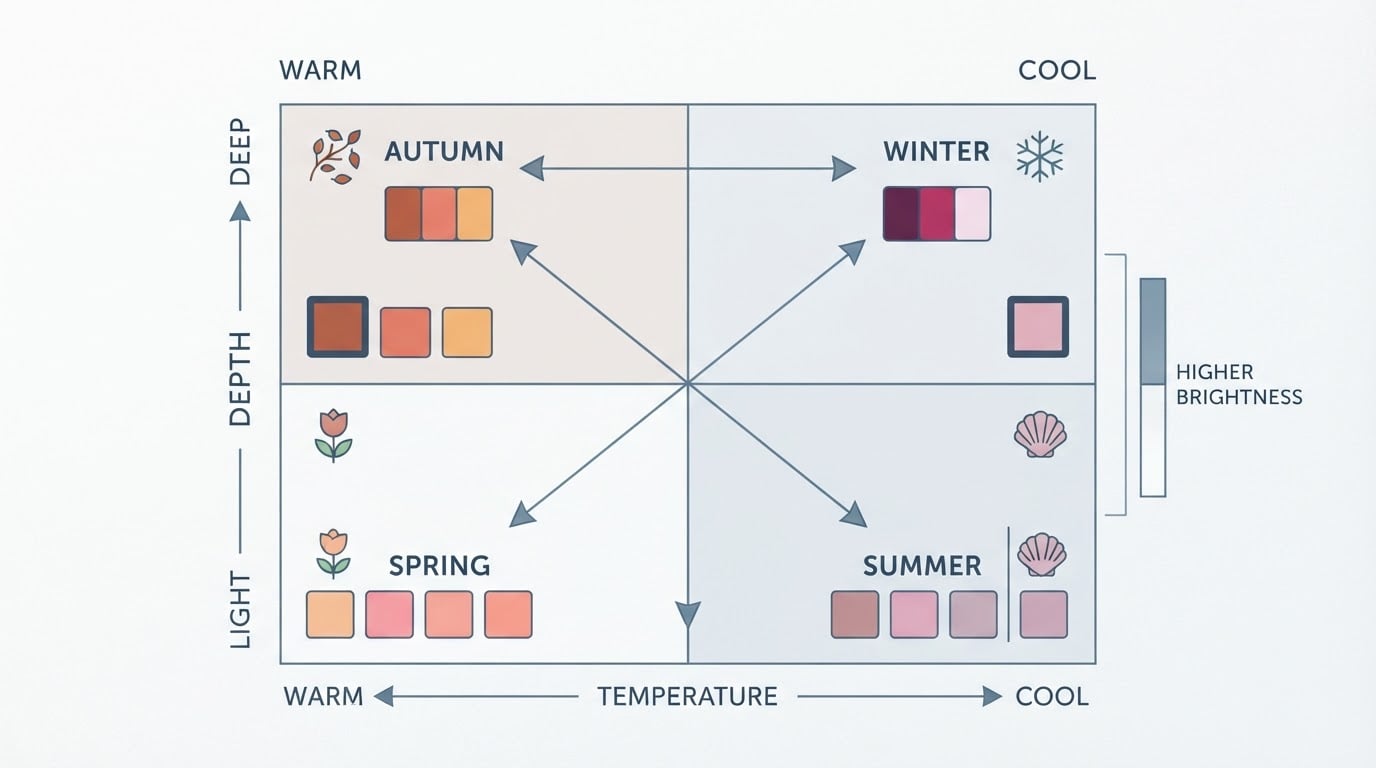
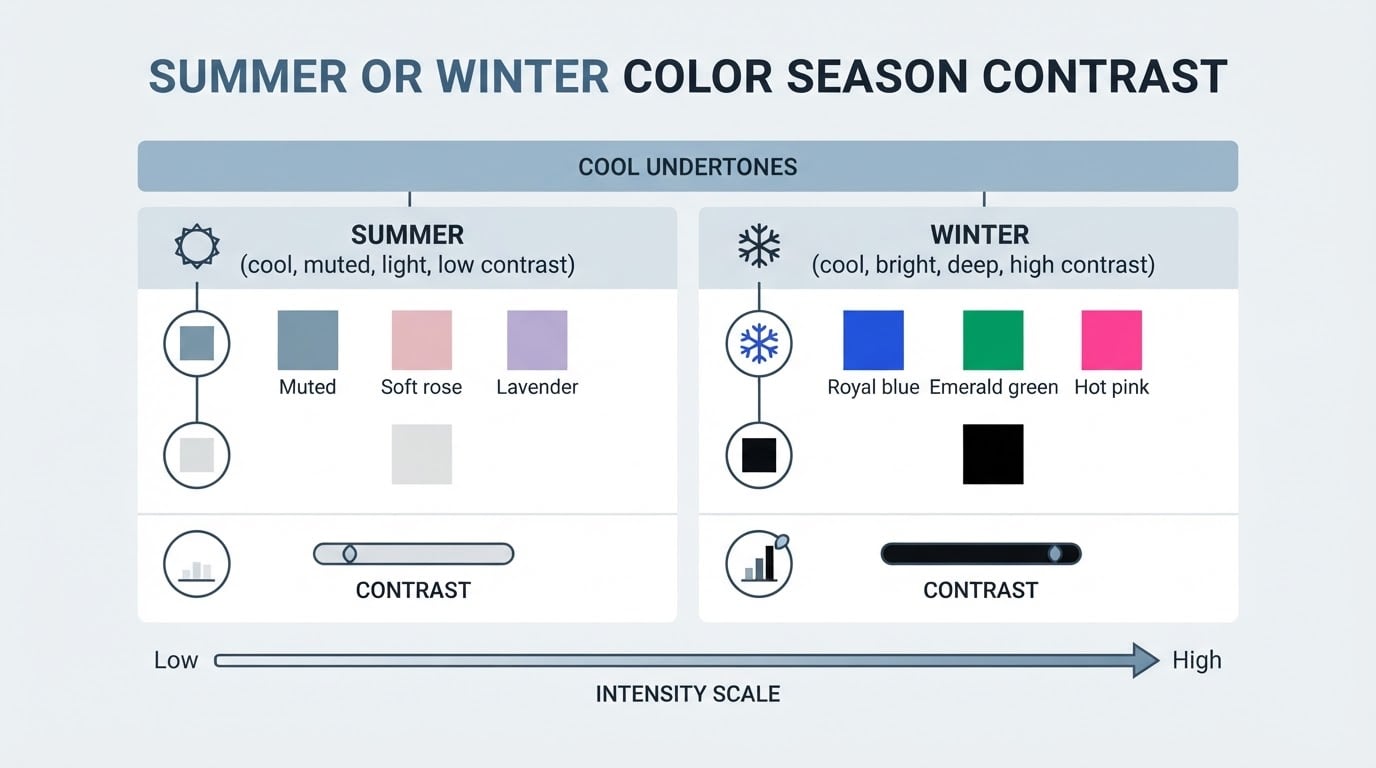
You are choosing between Summer and Winter only if your undertone is cool — blue-based rather than golden — because both seasons sit on the cool side of the color wheel. The real split is intensity. Summer is cool, muted, and light-to-medium with low-to-medium contrast, while Winter is cool, clear, and medium-to-deep with high contrast. If bright cobalt, pure white, and true black make your face look clear and awake, you lean Winter. If those colors overpower you but soft slate blue, dove grey, and dusty rose make you look rested, you lean Summer.
Key answers at a glance
- Which season is lighter? Summer. Its colors carry more white and grey, so even its darkest navies read closer to slate than to true navy.
- Which season is more intense? Winter. Its palette is saturated and includes pure white and true black as usable neutrals.
- Which season has more contrast? Winter. Summer's features blend together; Winter's features keep a visible light-versus-dark separation even in a grayscale photo.
- Which one can wear black and pure white? Winter, usually as core neutrals. Summer can still wear black, but it works better away from the face.
- What if both palettes seem plausible? That usually means you sit between two sub-seasons — most often True Summer and True Winter — and contrast is the test that decides.
Summer vs Winter Side by Side
Compare the two seasons on the three variables that professional color analysis measures — undertone, value (depth), and chroma (brightness) — and on the contrast that follows from them.
Trait | Summer | Winter |
|---|---|---|
Undertone | Cool, blue-based | Cool, blue-based |
Value (depth) | Light to medium | Medium to deep |
Chroma | Muted, soft, greyed | Clear, saturated, bright |
Contrast | Low to medium; features blend | High; strong light-versus-dark separation |
Flattering neutrals | Dove grey, slate, soft navy, taupe, off-white | Pure white, black, charcoal, true navy |
Flattering accents | Dusty rose, powder blue, soft raspberry, sage | Cobalt, emerald, true red, fuchsia, icy blue |
Metals | Silver and white gold, especially brushed or antique finishes | Silver and platinum, including high-shine finishes |
Handle with care | Black and pure white can look harsh | Dusty, greyed pastels can look washed out |
The fastest way to use the table: start with the neutral row. Your best neutral sits next to your face more often than any accent, so it decides more outfits than a favorite bright color does.
What it means for menswear. Summer reads well in soft navy, slate, and mid-grey suits, soft white or pale blue shirts, and ties in dusty blue, soft plum, or muted rose, with grey leather shoes completing the softer register. Winter reads well in charcoal and true navy suits, crisp white shirts, and ties in cobalt, emerald, or true red, with black shoes for evening. Deep indigo denim suits Winter; lighter, greyer washes suit Summer. If you color your beard, stay inside the same rule — deep and cool for Winter, softer and ashier for Summer.
Self-Check Signals You Can Test at Home
You can separate the two seasons at home with three tests. Run them in indirect daylight with no makeup, hair pulled back, and a plain wall behind you; that removes the two variables — cosmetic color and colored surroundings — that most often skew a self-check.
1. The grayscale photo test. Take a front-facing selfie in daylight and convert it to black and white. If your features still show clear light-versus-dark separation — dark hair and eyes against lighter skin — you have the contrast that Winter is built around. If the whole face reads as one blended tone, you lean Summer.
2. The four-color drape test. Hold each of these fabrics or clothing pieces just under your chin, one at a time: pure white, soft white or pearl grey, true black, charcoal, bright cobalt, and soft slate blue.

- Winter signals: pure white and black make your skin look clearer, and bright cobalt makes your eyes stand out without fighting them.
- Summer signals: soft white and charcoal flatter you more than pure white and black, and slate blue looks harmonious while bright cobalt pulls attention off your face.
3. The jewelry finish test. Both seasons can wear silver, so the metal color is not the tell — the finish is. If bright, polished silver or platinum looks settled on you, you have Winter's clarity. If brushed, satin, or antique silver looks better, you lean Summer.
Your completion standard. If two of the three tests point the same way, treat that result as your working season. If they split, the drape test decides, because fabric next to the face is the largest color surface any of the tests measures.
The most common mistake. Most people start by comparing warm against cool and then get stuck. Both Summer and Winter are cool, so that comparison cannot separate them. The variable that does separate them is intensity — how bright and how deep your best colors need to be — and that is exactly what a grayscale photo and a bright-versus-muted drape make visible.
If You Are Torn Between True Summer and True Winter
If your self-checks land between the two families, you are usually choosing between True Summer and True Winter: the deepest, coolest version of Summer, and the clearest, most classic version of Winter.
True Summer keeps Summer's softness with extra depth. You need muted, slightly greyed colors, and black or pure white usually stays hard to wear. True Winter keeps Winter's clarity with icy, high-contrast color. Black, pure white, and jewel tones work on you, while dustier shades tend to drain you.
The deciding question is whether you wear the high-contrast look or it wears you. Put on black with pure white, then bright cobalt, and check a photo rather than the mirror: if your face still reads first, choose True Winter; if the colors read first, choose True Summer.
Two neighboring sub-seasons catch most in-between cases. If you are a little too deep for classic Summer but not bright enough for True Winter, test Soft Summer. If depth is easy for you but the brightest icy accents are not, test Deep Winter. The wider 12-season system places three sub-seasons inside each family, so an in-between result is normal rather than a contradiction.
How to Confirm Your Summer-vs-Winter Read
Self-checks narrow the answer; a measurement-based second opinion can settle it. Tone & Fit, an iPhone color-analysis app, offers a free browser-based analyzer that it describes as measuring depth and undertone in the CIELAB color space from a photo, then returning a season plus five starter colors — no account required, with the photo processed in memory rather than stored. Treat a result like that as one strong data point to compare against the tests above, not a verdict to accept unchecked.

Desktop first-screen of the free web-based color analysis tool with photo upload drop zone, how-it-works steps, and privacy notes
A practical confirmation loop after any verdict:
- Pull two or three colors from the season the verdict names: one neutral, one accent, and one risk color such as black or pure white.
- Wear one per day in daylight and look at your skin, not the garment, in a mirror or a photo.
- Keep the season whose colors make your skin look even without extra concealer. If a Winter verdict keeps washing you out in black, retest the drape colors before you rebuild a wardrobe around it.
FAQ: Quizzes, Clothes, and Palettes
Is a Summer vs Winter quiz reliable? A quiz is a useful first filter, not a final answer. Quizzes ask you to interpret your own features, and because Summer and Winter share a cool undertone, one small misread — calling ash brown hair "golden," or mistaking a tan for warmth — can flip the result. Use the quiz output as a hypothesis, then confirm it with the grayscale, drape, and jewelry tests.
What should a Summer wear compared with a Winter? Summer leans on dove grey, slate blue, soft navy, taupe, off-white, dusty rose, powder blue, soft raspberry, and sage. Winter leans on black, pure white, charcoal, true navy, cobalt, emerald, true red, fuchsia, and icy blue. In both seasons, keep the boldest color on a small surface — a scarf, tie, lipstick, or bag — until you are sure it works next to your face.
How are the Summer and Winter palettes different? The Summer palette is cool and greyed: its lightest colors are powdery and its darkest are soft. The Winter palette is cool and clear: its lightest colors are icy rather than pastel, and its darkest include true black. The same hue can appear in both palettes — what changes is how much grey or white is mixed into it.
Can you be a Summer one year and a Winter the next? No. Your season follows undertone, value, and chroma, which stay stable over time. A tan, a hair dye, or different lighting changes how much contrast you show, not the direction of your undertone, so recheck the read instead of switching seasons.
Does dark hair mean you are a Winter? No. Dark hair is common in Winter, but a dark ash brown can sit in the deeper Summer sub-seasons. If you have dark hair with soft, low-contrast features, run the drape test before assuming Winter.
What if the tests say Summer but you love black? Keep black, but move it away from your face: trousers, skirts, shoes, and bags rather than a top or scarf. Pair it with a Summer neutral near your face — soft navy, dove grey, or off-white — and the contrast stays manageable.