Winter Colors to Shop First: A First-Purchase Plan
If you typed "my color season quiz says winter what colors should I shop for first" into a search bar, you already have the useful half of the answer: your result says Winter. The second half is about order, not volume. A Winter result is not a shopping list of every shade your palette can hold. It is a direction — cooler, clearer, deeper color relationships than the ones that tend to wash you out — and the smart first move is a small set of purchases you can verify against your own closet, your own lighting, and the palette that came with your result.
This guide keeps that first trip deliberately small: audit what you own, choose one practical dark neutral, add one light neutral that works with your wardrobe, select one blue or blue-green option, and buy one cool-leaning accent you actually like. Bright, Cool (or True) and Deep Winter call for slightly different depth and brightness, so the subtype on your result matters. Nothing here is a universal rule: color names are shorthand, not laws, and the palette you received is your reference.
What a Winter result can — and cannot — tell you
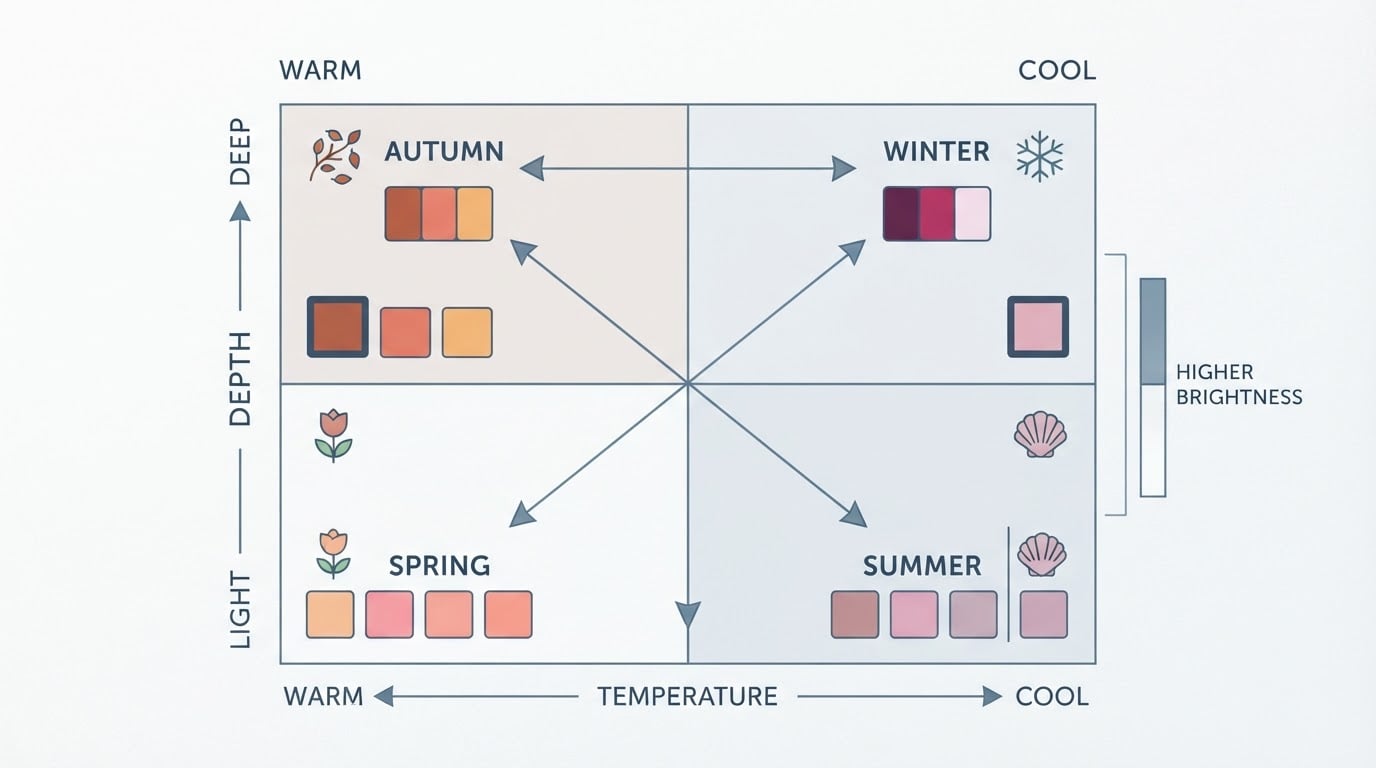
A general Winter result places you in the cool, clear, higher-contrast end of the color system. In most 12-season systems that family splits into three sub-seasons with different names depending on the school: Bright Winter (also called True or Clear Winter), Cool Winter (also called True Cool Winter), and Deep Winter (sometimes called Dark Winter). Each shares a cool, blue-based foundation, but they shift the dials differently — one on clarity, one on pure coolness, one on depth.
What the result cannot do is name the exact shade of every garment that will suit you. Two systems may label the same color differently, and two retailers may use one color name for noticeably different fabrics. Treat your result and its palette as a working reference: check which subtype it names, notice whether it emphasizes brightness, coolness, or depth, and let the mirror — not the label — make the final call on each garment.
Audit your closet before you buy anything
Before a single purchase, sort your closet by what you actually wear, not by what you think a Winter wardrobe should contain. A teacher who lives in knits may already own three black sweaters and zero cool gray ones; a supervisor who wears hoodies and jeans all week may need exactly one versatile dark layer; a traveler building a carry-on capsule may discover the real gap is a crisp light top that works under everything.

List the categories you reach for weekly, then note what is missing in each. The point of the audit is to convert a palette into a short gap list — usually three to five items — so the first shopping trip fills holes instead of collecting duplicates. You do not need to discard warm pieces you enjoy; you need to know what is genuinely absent.
Choose one practical dark neutral
Dark neutrals do the heaviest lifting in a Winter wardrobe because they sit near the face less often and pair with almost everything. Charcoal, cool navy, and black are common across Winter palettes; deeper-leaning versions such as midnight navy or blue-black appear often in Deep Winter references. Pick the one your closet lacks most, in the category you wear most: a charcoal trouser for an office-heavy week, a cool navy overshirt for casual days, a black knit for layering season.
One is enough for the first trip. A single dark neutral that coordinates with your existing light and mid pieces will earn more wears per dollar than three similar darks bought together, and it gives every later purchase an anchor to match.
Add a light neutral that works with your wardrobe
Winter palettes commonly include crisp, cool whites and light grays — optic white, crisp white, cool gray, and icy tones — while cream and ivory often read warm by comparison. Check the palette from your result, then choose one light neutral that works with the dark neutral you already picked and the clothes you own today.
A crisp white button-up covers office dress codes and weekend layering alike; a light gray knit suits climates where you layer indoors; an icy or optic-white tee is a low-cost, high-use base in warmer weather. If your wardrobe skews warm in its whites, this single piece is often the highest-leverage purchase of the whole first trip.
Select one versatile blue or blue-green option
Blue is the most wearable family color for most Winter results, and blue-greens travel well with it. Cobalt, royal blue, sapphire, and ice blue are recurring examples in Winter palettes, with deep teal and cool pine or emerald appearing as the blue-green end of the range. Choose one piece in a shade your own palette actually lists — a sweater, a shirt, a jacket — that pairs with both neutrals you selected.
Blue also bridges to denim, so a cobalt or royal knit over your existing jeans tests the color with almost no additional risk. If your result is Bright Winter, lean toward the clearer end of the blue range; if it is Deep Winter, the deeper navy-teal end may sit more naturally. Your palette remains the tiebreaker.
Buy one cool-leaning accent you actually like, not every suggested color
Palette pages list many tempting shades — cool raspberry, magenta, fuchsia, blue-reds, emerald, deep plum, pure violet — and none of them is a requirement. Overbuying accents is the most common first-trip mistake, because accents are the colors that look best in the store and worst in a drawer. Choose one cool-leaning accent you genuinely enjoy, in one piece you will wear soon: a scarf, a top, a bag, or a blazer.
If the choice is hard, take the accent that appears most often in your existing wardrobe's favorites — it is the one you are most likely to keep wearing. You can always add a second accent on a later trip, after the first one has proven itself in real outfits.
Prioritize pieces worn near the face when useful
Colors near your face do the most work, because that is where the eye goes first. Tops, knits, collared shirts, scarves, and jackets all sit in that zone; trousers, skirts, and most shoes influence an outfit far less. When a budget is tight, spend it on the near-face version of your chosen colors: a fuchsia blouse instead of fuchsia trousers, a cobalt scarf instead of cobalt sneakers.
This is also the friendliest rule across dress codes and climates. An office worker can shift color with a blouse or tie; a casual-dress employee can use a knit or hoodie; anyone in a uniform-heavy job can still introduce their palette through a scarf, cardigan, or jacket worn on breaks.
Adjust depth and brightness for Bright, Cool and Deep Winter results
The general Winter direction stays the same, but your subtype changes where you sit on depth and brightness. If your result names Bright Winter (True or Clear Winter), the clearer, more saturated versions of colors usually serve you best — full-strength cobalt, true red, optic white — while grayed or dusty versions tend to fall flat. A Cool Winter result points to the pure-cool end of the range: blue-based shades with no warm drift, from icy lights to cool darks. A Deep Winter result leans darkest and richest: midnight navy, black cherry, deep pine, and near-black neutrals carry more presence than mid-tone versions.
Treat these as tendencies to test, not verdicts. Naming systems differ, so read the palette that came with your result and compare real garments in consistent lighting — a "bright" shade that feels loud on you and a "deep" one that feels heavy are both signals to move along the range.
Test candidate colors in consistent lighting with complete outfits
Store lighting is the classic trap: warm bulbs push cool colors yellow, and overhead spots make depth hard to judge. Test every candidate in daylight when you can — near a window or just outside the fitting room — and compare two adjacent shades side by side rather than trusting a tag. A quick phone photo of the garment held near your face lets you compare it against a color you already know works.

Then test the full outfit, not the single item: the top with the trousers or skirt you plan to wear, plus the layer and shoes. A color can be perfect on its own and still fight the rest of the look. For online purchases, look for natural-light product photos, and keep return policies in mind — a home check in your own lighting is the final test.
A first-shopping-trip checklist — and the overbuying traps to skip
Before you buy, run each candidate through this checklist:
- Your result and palette are open, and you know whether it leans Bright, Cool, or Deep
- The item fills a gap from your closet audit, not a gap the store invented
- It is the one dark neutral, light neutral, blue or blue-green piece, or single accent you planned — not an extra
- The shade is cool-leaning and clear enough for your subtype, per your palette
- You compared it with an adjacent shade in daylight and it still holds up
- It completes at least one full outfit with clothes you already own
And skip the traps that empty wallets: buying every suggested color at once; trusting retailer color names over your palette; choosing only brights with no neutrals to anchor them; replacing a wardrobe that mostly works; and judging colors under fitting-room lights alone. Skipping is a decision, not a failure.
Run a free Tone & Fit analysis if you want a second read
If you reached this page before taking a quiz, or you want a second opinion on which Winter subtype fits, the free Tone & Fit color analysis reads your undertone, value, and chroma from one photo and returns your closest color season with starter colors — no account needed. The Tone & Fit app goes further with your full palette, colors to avoid, and the ability to drape all 12 palettes over your own photo, so you can preview how a first-shopping shortlist looks on you before you buy.

Desktop first-screen of the free web-based color analysis tool with photo upload drop zone, how-it-works steps, and privacy notes
Use any analysis as a starting point, not a guarantee. Take the small list from this guide — one dark neutral, one light neutral, one blue or blue-green piece, and one accent you love — compare everything in daylight, and let your mirror and your own wardrobe have the final word.